


There are cities we dream of long before we ever see them, and for me, Athens was one of those quiet, persistent dreams. Wrapped in mystery and wonder, it first entered my imagination through philosophy—Socrates, Plato, Aristotle, Epicurus. I was always fascinated by how a single corner of the world could shape minds that went on to shape humanity itself.
Later came ‘Zorba the Greek’, one of my all-time favourite books. Although Kazantzakis set his story in Crete, something about his Greece—its spirit, its contradictions, its warmth—deepened my curiosity. I wanted to walk where the ancient thinkers walked, to stand beneath the Acropolis, and to see the people behind the stories.
And finally, after years of imagining, I arrived. Four days in Athens: mostly rain-soaked, one radiant day of sun, and countless moments quietly stitched into memory. I wandered through ruins and living streets, met strangers who felt strangely familiar, and discovered a city far more layered and complex than any book had promised.
Day 1: Running Toward the Sun (and Meeting the Rain Instead)


Travelling to Athens felt like running toward the sun, escaping the grey drizzle of London. But rain, it seems, is loyal to us—we landed on a rainy afternoon. My first encounter with Athens wasn’t its ancient monuments or marble ruins, but the graffiti. Everywhere. Bright, chaotic, alive.
For some reason, I had expected Athens to resemble Istanbul, but it was completely different—rawer, more direct, more expressive.
Since it was raining and we were exhausted, we didn’t explore much that first day. We visited friends, took a slow walk through the city centre, and ended the night with a lovely dinner. But the moment that stayed with me most was seeing the Acropolis glowing above the city at night—my first glimpse of the ancient world quietly watching over everything.
Day 2: Acropolis, Plaka, and the City in the Sun


The sun returned generously on our second day—warm, bright, and kind, as if Athens was making up for all the rain. Feeling lighter and happier, we headed toward the Acropolis, walking slowly and letting the city lead the way. On the way, we stopped at Panaghia Kapnikarea Church, a small and lovely 11th-century Greek Orthodox church quietly standing in the middle of the city’s constant movement.


From there, we walked toward the Roman Agora of Athens, on the northern side of the Acropolis. It was actually the first historic site that truly caught my attention the night before—it looks magical after dark. Seeing it again in daylight felt softer, more alive. I took far too many photos and spent a good amount of time admiring the true rulers of the place: the cats, stretched out in the sun like gods, fully aware of the attention they were receiving.


The most striking structure there is the Tower of the Winds, also known as the Horologion of Andronikos. This octagonal marble building, dating back to the first century BC, is often considered the world’s first meteorological station. It once functioned as a clock, sundial, weather vane, and compass all at once. Over the centuries, it was even used as a church—just another layer added to its long, complicated life.
Walking through the area, it became clear how many times this part of Athens has been reshaped. Invasions by the Venetians and the Ottomans left their marks, with ancient ruins giving way to houses, workshops, churches, and mosques. All these layers still exist side by side today. The Fethiye Mosque, standing quietly next to the Roman Agora, felt like a reminder that Athens has never belonged to just one time—it has always been many cities at once.


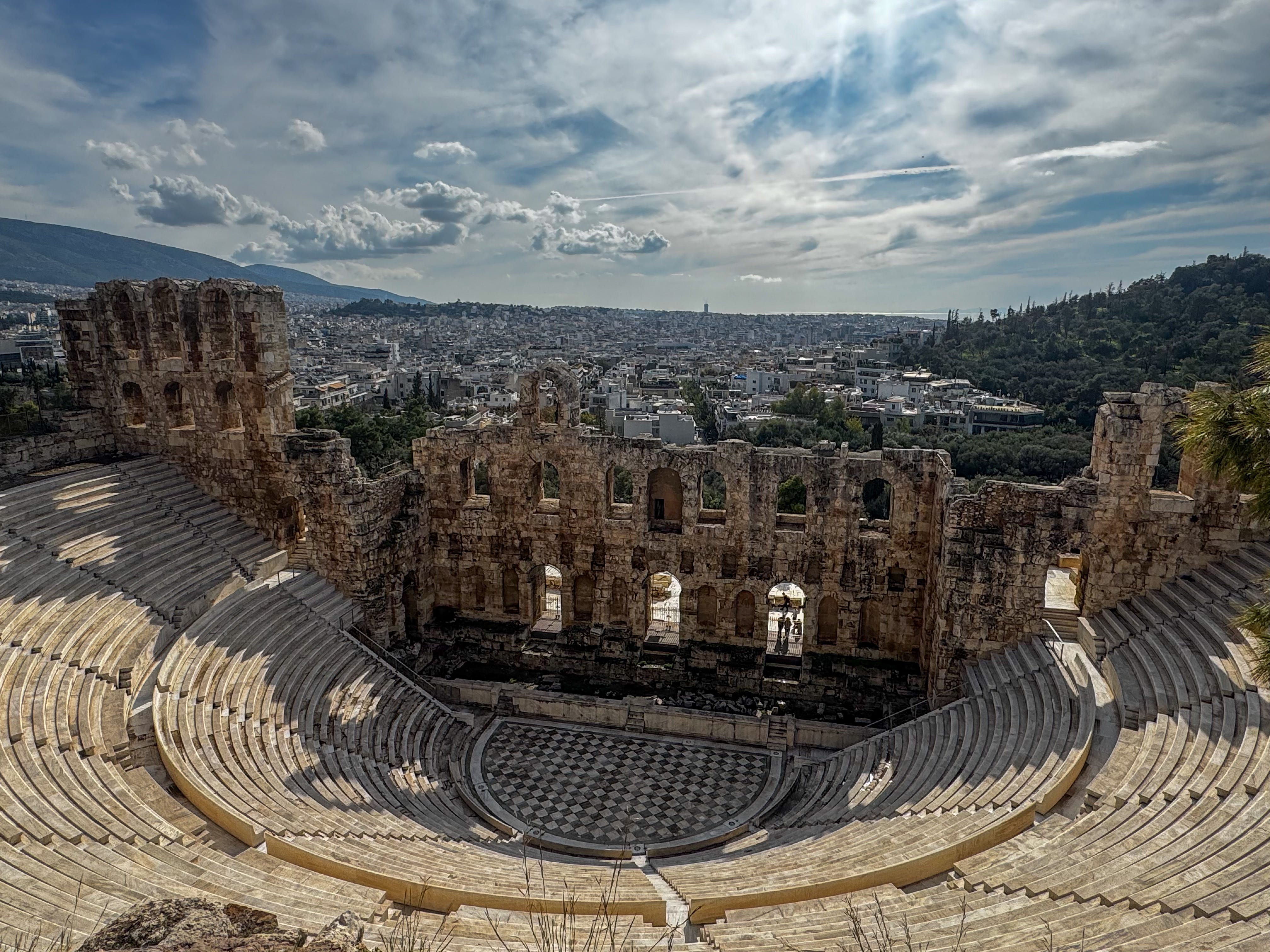
Our next stop was the Acropolis of Athens—the main reason I had always wanted to visit this city. After a pleasant walk and a steady climb under the Athenian sun, we finally reached the citadel. The first structure we encountered was the Odeon of Herodes Atticus, a stone theatre commissioned in 161 AD by the wealthy Athenian magnate and Roman senator Herodes Atticus, in memory of his late wife, Aspasia Annia Regilla. If you’re lucky enough to visit during a performance, you can sit on the ancient stone seats and experience history as something alive.
Next came the Parthenon, the iconic former temple dedicated to the goddess Athena. Standing in front of it felt surreal—one of those moments when something you’ve seen in books and photos suddenly becomes real.
My favourite building, though, was the Temple of Athena Polias, known today as the Erechtheion. This elegant Ionic structure once housed the statue of Athena Polias and is believed to encompass two sacred buildings mentioned by the ancient geographer Pausanias: the Temple of Athena Polias and the sanctuary of Erechtheus or Poseidon. It felt less imposing than the Parthenon, but more intimate—and deeply moving.
After exploring these spectacular places, we simply stood and looked out over the city from the Acropolis. Athens stretched out below us like a painting—soft, layered, endless.


We had lunch at Ristorante Atlantikos afterward. The seafood was excellent and surprisingly reasonably priced. Full and tired, we wandered through Plaka, the oldest and most picturesque neighbourhood in Athens, often called the “Neighbourhood of the Gods.” It quickly became my favourite street in the city—full of character, vibrant, and alive. Sadly, my phone died, and I couldn’t take many photos.
We returned to the hotel, then headed back to the city centre for dinner and shisha. The funniest part? They didn’t have black tea. For us, as Iranians, shisha without tea feels almost impossible—but we survived!
And just like that, Day 2 came to an end.
Day 3: Seaside, Bookshops, and More Cats


Day 3 began with a visit I had been looking forward to the most: Little Tree Books and Coffee.
It instantly reminded me of the book cafés in the north of Tehran—warm, artistic, and welcoming. I finally tried Greek coffee… and to my surprise, I didn’t like it at all (sorry!). Another surprise: books were more expensive than in the UK. Thanks, UK.


Later, we went to meet our friends, who had recently opened a café-bakery—one of the branches of Veneti, one of the largest café chains in Greece. As you can imagine, we were spoiled with free coffee and pastries (thank you, Homa and Babak!). From there, we headed to the seaside. It was rainy again, so we couldn’t fully enjoy the sea, but it was still peaceful and beautiful. Next time, I might come to Greece just for the seaside alone.
After another delicious seafood meal, we returned to the hotel to rest and prepare for our last day.
Day 4: One Last Coffee, Then Home


After one last coffee at our friends’ café, we went out for a final walk around the city. I stopped at Wild Souls Café for another coffee—this one I enjoyed much more. It felt youthful, modern, and energetic, like seeing Athens through a younger lens.


Last but not least, what I loved most about Athens wasn’t its historical sites, but its cats. Everywhere you looked, there they were—beautiful, majestic, and clearly the true rulers of the city. 🐈✨ That’s what makes Athens so special.
And then it was time to head to the airport. We missed Leo and Leni terribly, and as much as I loved this trip, I couldn’t wait to go home to them. They were just as happy to see us, too.
This was my first travel blog. I hope you enjoyed it. If you have any suggestions—or would like me to write more stories like this—feel free to leave a comment. 💛
Thanks for reading☺️ If you liked this post, press ❤️ and share it with your friends!
I really enjoyed this read! Some of the pictures do remind me of northern Tehran even though I haven’t visited in many years. I randomly came across your article and was pleasantly surprised you’re Iranian as well :) The pictures are beautiful. And I really appreciate the ending being dedicated to all the cute cats.