


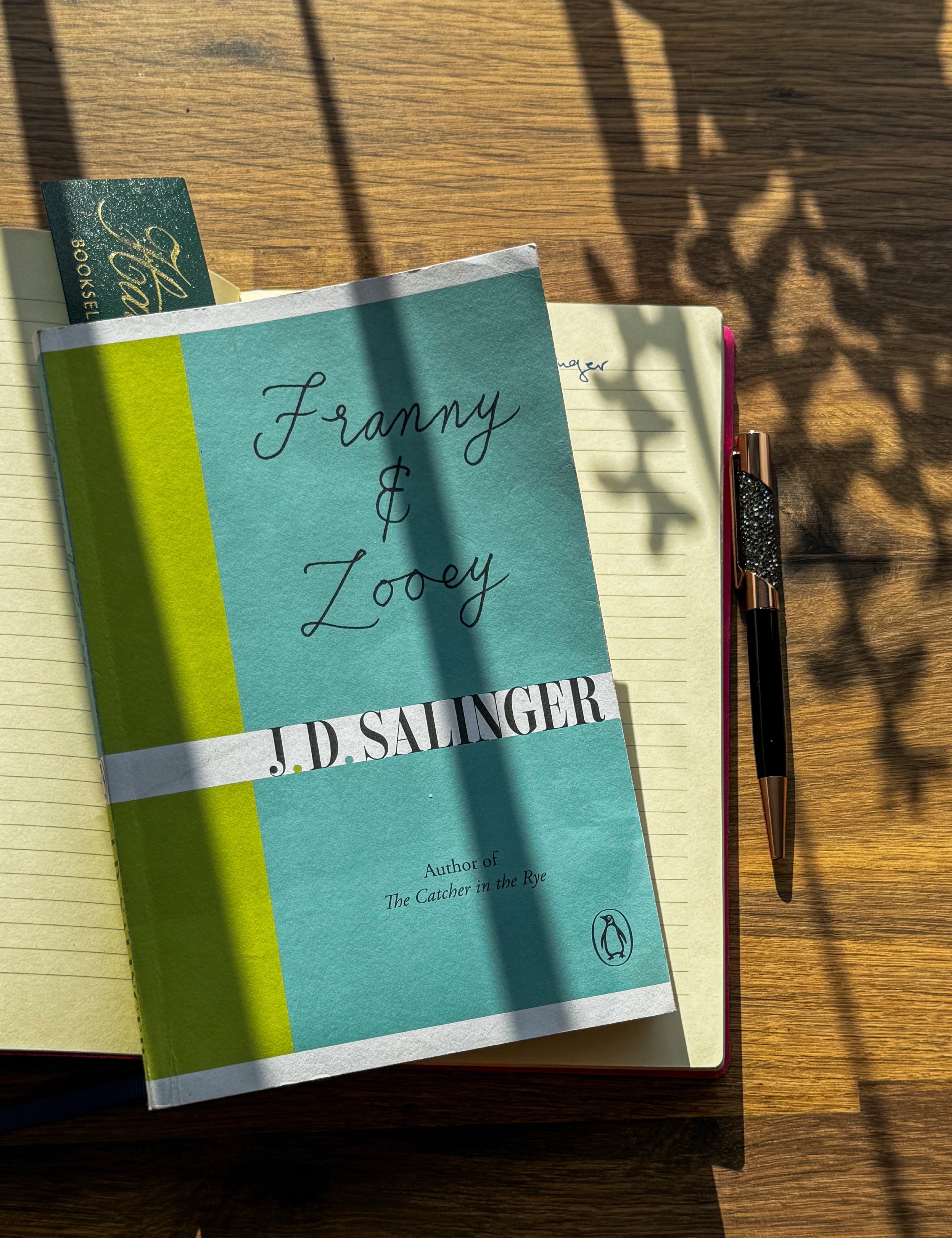
Some books hold a kind of quiet magic — not the kind that fades, but the kind that waits. All you need to do is return to them after enough time has passed, and they open differently. Franny and Zooey is one of those books.
I came back to it expecting to enjoy it differently. I didn’t expect it to feel this good.
When You Are Twenty and Certain of Everything
When I first read it, I was in my early twenties — that particular age when you are convinced the world doesn’t quite understand you, and you find that thought more thrilling than troubling. I was deep into philosophy and mysticism. I felt everything intensely and thought that intensity set me apart. I was, in other words, very much like Franny.
A colleague introduced me to the book by telling me it was the source material for Pari, one of Iran’s most significant films. I read it immediately.
Reading it again now, I recognise Franny’s sensibility in myself — but from a greater distance. I’m less emotional about the world’s absurdities, more quietly amused by them. The ridiculousness she finds unbearable, I’ve learned to hold more lightly.
The Glass Family
The novel follows the two youngest members of the Glass family — a brilliant, eccentric New York clan of former child radio prodigies. It moves in two parts.
The first belongs to Franny: her unravelling, her retreat into a small Russian spiritual text about the Jesus Prayer, and the collapse that follows. The second belongs to Zooey: sardonic, fiercely intelligent, trying in his oblique way to reach his sister.
What stays with me is the book’s climax — Zooey’s speech about the Fat Lady. Their late brother Seymour had told them, as performing children, to do everything for the Fat Lady: an ordinary, unglamorous woman sitting on her porch with the television on. Zooey’s revelation is that the Fat Lady is everyone. That love for the everyday, unglamorous world is not a concession — it is the whole point.
J.D. Salinger: The Writer Who Disappeared
To read Franny and Zooey is to inevitably reckon with its author — because Salinger himself is a kind of Glass sibling. Brilliant, allergic to the world’s noise, and ultimately unwilling to keep performing for it.
He published The Catcher in the Rye in 1951 and became, almost against his will, one of the most celebrated writers in America. He hated it. By the mid-1960s he had retreated to a small house in Cornish, New Hampshire, where he lived in near-total seclusion for the remaining forty-five years of his life — still writing, reportedly, but publishing nothing.
There is something deeply Franny-ish about this. The same exhaustion with performance. The same longing for something purer, something that doesn’t require you to smile for an audience you’ve lost faith in. Salinger didn’t find his Fat Lady. Or perhaps he did, and decided she was best loved in private.
Franny and Zooey was published in 1961, drawn from two stories that had appeared in The New Yorker. It remains, for many readers, his most intimate work — the one that feels least like literature and most like overheard conversation.
The Tenenbaums: A Different Family, the Same Ache
If the Glass family ever moved to cinema — not to the Iranian art house tradition that gave us Pari, but to the wry, melancholic world of American indie film — they might have ended up as the Tenenbaums.
Wes Anderson’s The Royal Tenenbaums (2001) tells the story of another brilliant, dysfunctional family of former prodigies, all of them damaged in adulthood by the weight of early promise. The stories are entirely different, but the emotional texture rhymes: the same sense of people too sensitive and too clever for ordinary life, retreating into themselves, circling each other with a mixture of love and frustration and unresolved grief.
Both the Glasses and the Tenenbaums are haunted by an absent figure — for the Glasses, it is Seymour; for the Tenenbaums, it is the father, Royal, whose failures cast a long shadow. Both families speak in a kind of heightened, oblique language that is simultaneously funny and heartbreaking. And in both, the resolution — if you can call it that — comes not through triumph but through a quiet decision to love the imperfect world anyway.
Anderson has never cited Salinger as a direct influence on The Royal Tenenbaums, but it is hard to imagine the film existing without that particular literary lineage. The DNA is there in every perfectly composed frame of barely-contained feeling.
Dots in an Infinite Field
This brought me, unexpectedly, to Yayoi Kusama. Her polka dots — infinite, repeating, each one whole and each one part of something larger — feel like a visual answer to Zooey’s speech. We are all dots in an endless field. Connected, whether we feel it or not.
Some books remind you of that. Franny and Zooey is one of them.
this was a glorious exploration of my single favorite text. thanks for sharing your insights and care for the work ✨
I always love recommendations/ inspirations for reading