


When you leave your familiar surroundings and enter a new world, what makes you the same person when you return? Can you ever truly be the same person after experiencing a world so different from your own?
I went to my favourite Waterstones in Hampstead, looking at the countless piles of books, with absolutely no idea what to buy. I’d been thinking about reading Piranesi for some time, but I wasn’t sure if it was what I needed at that moment.
Then I did something new: I asked ChatGPT for a recommendation, and its first choice was Piranesi! I swear, all these thoughts were already in my head, and I’d never mentioned the book to it. It made me wonder whether perhaps our thoughts are more visible than we think!
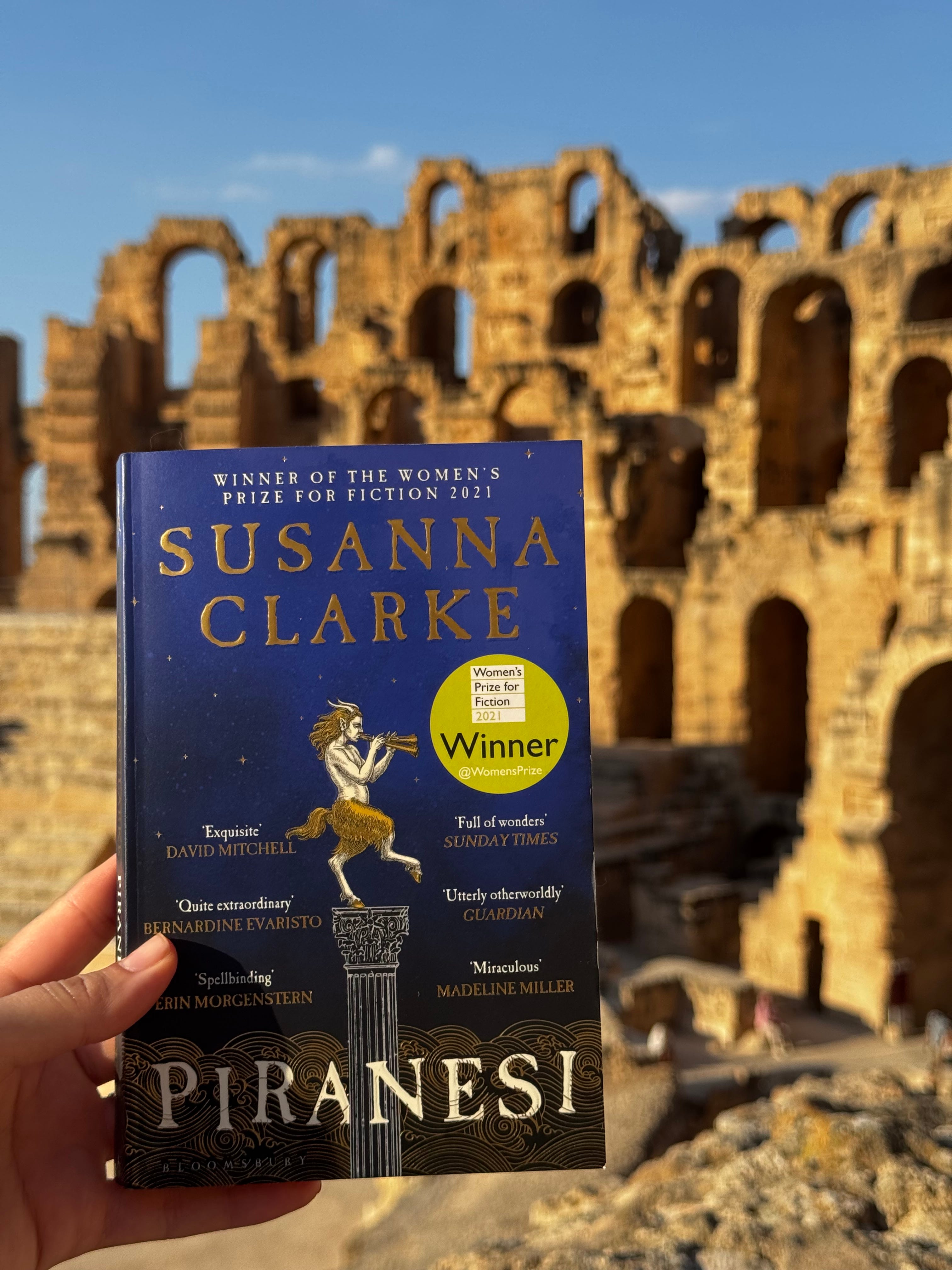
Anyway, I took Piranesi on holiday with me to Tunisia. I even took it to the El Jem Amphitheatre, which, at certain angles, reminded me of the House where Piranesi lives. Of course, there’s one big difference: the House is surrounded by the sea, whereas El Jem stands in the middle of the Tunisian’s dry landscape.
I read a few pages, took some lovely pictures of the book and brought it back home. By then, I was hooked. I finished it over a few reading sessions and absolutely loved it!
The story follows a man named Piranesi, who lives in a mysterious place he calls the House. It’s an extraordinary world made up of endless halls, enormous marble statues and vast staircases, with an ocean running through its lower levels and clouds and tides shaping its different spaces.
Piranesi knows only one other person, whom he calls the Other. He spends his days exploring the House, documenting its rooms, studying its tides and looking after the remains of those who once lived there. The Other visits him occasionally, and together they seem to be searching for something, although Piranesi doesn’t quite understand the bigger picture.
What makes the story so fascinating is the way Susanna Clarke gradually reveals the mysteries of this world. At first, we experience everything through Piranesi’s eyes. He seems completely at peace with his surroundings, finding beauty in the statues, the birds and the ocean. But as the story unfolds, little details begin to feel unsettling. Questions start to emerge about the House, the Other and Piranesi’s own past.
It’s a story about much more than a mysterious house. It explores memory, identity, loneliness, knowledge and what makes us who we are. It also makes you question how much of our identity is shaped by the world we live in and the things we remember.
Susanna Clarke surprises you with her wonderful storytelling. The first few pages might feel a little confusing and slow, but once you get into the story, it’s impossible not to fall in love with this extraordinary world.
Piranesi won the 2021 Women’s Prize for Fiction. One thing I particularly loved about this book is how incredibly visual it is. While reading it, I kept imagining what the House would look like on screen. I really hope someone makes a film adaptation one day!
In some ways, it reminded me of The Truman Show, but with a much more fantastical world and a completely different atmosphere. And the good news is that there’s going to be a stage adaptation in the UK next year, which I’m really looking forward to seeing.
My own takeaways
Of course, everyone takes something different from a book, and these are the thoughts that resonated with me the most.
I keep coming back to the question I started this review with: when you leave your familiar surroundings and enter a new world, what makes you the same person when you return?
When I think about the person I was before emigrating, sometimes I feel as though I don’t know her at all. She’s familiar, but at the same time, she feels like someone I’ve left behind.
And when I think about returning to my home country, I wonder who I’d be there. Would I still be the person who once lived there, or would I be the person I’ve become here? Perhaps neither.
In some ways, I relate to Piranesi’s sense of displacement. I sometimes wonder whether, after living between two different worlds, I might end up feeling like a ghost in both of them, not quite belonging to either and struggling to recognise where I fit in.
Perhaps that’s one of the things I took away from this book: how much of our identity depends on the places we inhabit, the memories we carry and the experiences that change us along the way.
Have you read it? I’d love to know what you thought.
A little note about writing again
I came back with this short review, and I’m trying to push myself to write more. Not necessarily to produce something perfect, but as a meditative way of putting my thoughts somewhere.
I’ve been in my own head for quite a long time, and getting back into the habit of writing and putting down what’s happening around me hasn’t been easy. Sometimes, you have so many thoughts that you don’t quite know where to start.
But it’s never too late to start again, is it?
Thanks for reading. If you liked this review, press ❤️ and share it with your friends!