


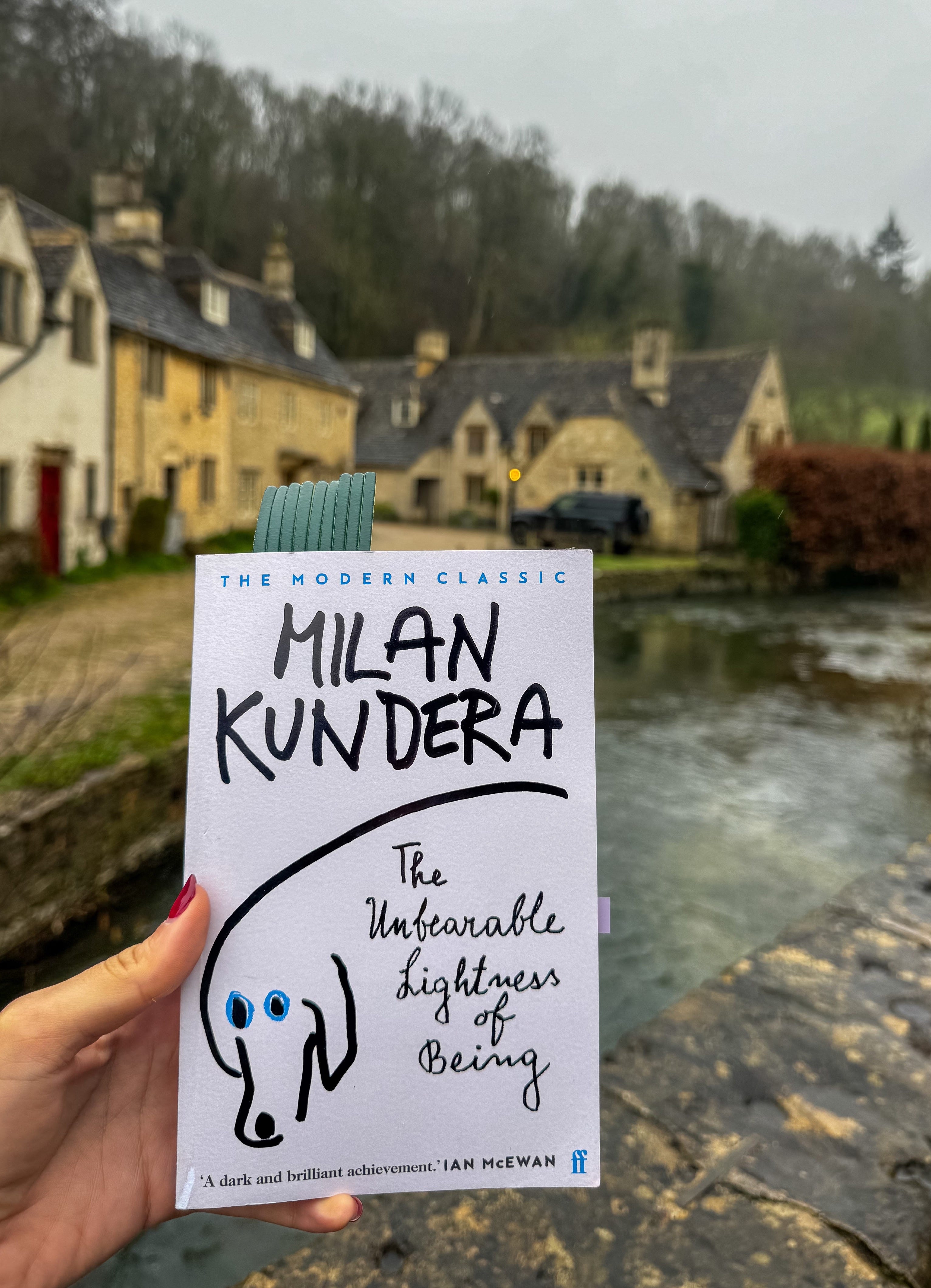
To understand a work, one must first understand the context in which it was created. Only then can we begin to grasp it in its full depth.
Today marks 5 weeks since Iran was struck by the USA and Israel. Nearly three months have passed since the massacre of protesters, and more than a month since the country was plunged into a complete internet blackout.
I mention this because the state of mind I carried into reading The Unbearable Lightness of Being inevitably shaped my experience of it.
I had bought the Farsi translation years ago, but could never finish it. Only now, reading it in English, did I realise why: censorship had hollowed it out. Something essential—its spirit, its boldness—had been stripped away, leaving behind a text that felt muted, almost lifeless.
This time, I returned to it because its name would not leave me. It echoed insistently in my mind—perhaps because I, too, have been feeling the unbearable weight of being.
I finished it a few days ago, and I loved it. It is the kind of book that lingers, that quietly settles within you and refuses to fade—like Nausea or The Metamorphosis.
At first glance, it appears to be a philosophical meditation on love, centred around a Don Juan figure. But it unfolds into something far greater: a reflection on existence itself. Life, in all its contradictions and fragility, is examined through the intertwined perspectives of its characters—each one illuminating a different facet of being.
The opening
The opening is fascinating, beginning with the idea of eternal return—a promising beginning to an extraordinary book:
To think that the recurrence itself recurs ad infinitum! What does this mad myth signify?
Through the idea of eternal return, Kundera reflects on whether our actions carry any real weight in a life that happens only once. Through love, history, and political reality—and through his four central characters—he makes us question whether anything we do truly matters, or whether it is all, in the end, unbearably light.
Kundera does not treat eternal return as something real; he uses it as a thought experiment.
If everything in life repeated infinitely, then our choices would carry immense weight, because we would have to live them again and again.
But if life happens only once, as it seems to, everything becomes light — and lightness, Kundera suggests, is not the relief it might appear to be. Without repetition, our choices lose their weight, their consequence. And yet this is precisely what makes lightness unbearable: happiness, he argues, is the desire for repetition. A life that occurs only once is a life in which true happiness remains forever out of reach.
Characters
Tomas is the protagonist—a middle-aged, successful, womanising doctor who falls in love with Tereza, a young waitress escaping the suffocating world of her mother — a controlling, immodest woman whose hold on Tereza amounted to a kind of degradation
Tomas and Tereza stand at the centre of the novel, embodying two opposing ways of experiencing love—and, in many ways, life itself.
Tomas begins as a man devoted to lightness. A successful surgeon and a committed womaniser, he separates love from desire, refusing to let emotional attachment limit his freedom. For him, relationships are meant to be light, without burden or consequence. Yet his encounter with Tereza unsettles this carefully constructed world.
Tereza, in contrast, is defined by her longing for weight. She seeks depth, exclusivity, and meaning in love. Her relationship with Tomas is not just romantic; it is existential.
Their relationship becomes a constant tension between lightness and weight. Tomas resists commitment, yet finds himself repeatedly drawn back to Tereza. Tereza, meanwhile, suffers under the lightness of his infidelities, experiencing them not as freedom but as a kind of erasure.
To me, it felt as though she was trying to create the idea of a family she never had—Tomas becoming, in a way, her mother, father, lover, and husband, and Karenin(their Dog) their child.
My favourite character, however, is Sabina—a free-spirited painter and one of Tomas’s mistresses.
Sabina represents lightness taken to its extreme. She rejects all forms of attachment—home, country, relationships—constantly moving, constantly betraying. For her, betrayal is not cruelty, but a form of freedom.
And, Franz, a university lecturer, on the other hand, longs for weight. He seeks meaning in commitment, ideals, and grand gestures. But Kundera presents this with irony—Franz’s need for meaning often blinds him, drawing him towards illusions rather than reality.
The idea of home
A person who longs to leave the place where he lives is an unhappy person.
I moved to a different city at 18, another at 22, and then to a different country at 32. When I told my mum I was leaving, she said: You left this city because you were unhappy. Now you’re leaving the country to find happiness—what will you do if you can’t find it there either? Move to the moon?
The novel takes place during the Soviet invasion of Czechoslovakia, when Tomas, Tereza, and Sabina leave their country in search of a better life. I don’t think I have ever felt a book more deeply than I do now.
Tereza leaves to find happiness, Tomas leaves for her, and Sabina leaves for freedom.
Yet Tereza cannot find happiness abroad—just as she could not find it by escaping her mother. Maybe happiness is not something we find externally, no matter how far we run.
Kitsch
Kundera uses the concept of kitsch to give us a deeper understanding of what he is trying to say. To him, kitsch is the denial of everything in human existence that is unacceptable—wiping away all ugliness from the surface and creating a falsely beautiful reality to make people happy. A lie we choose in order to make our lives bearable.
For Kundera, kitsch is not simply a matter of bad taste, but a way of seeing the world—one that denies everything uncomfortable, complex, or contradictory in human existence. It is the desire to turn life into something simple, beautiful, and emotionally satisfying, where suffering, doubt, and imperfection are erased.
Through both his characters and the political backdrop of the novel, he reveals how kitsch operates—in idealised love, in grand political narratives, and in our own need for comforting illusions. In contrast to the raw ambiguity of life he presents elsewhere, kitsch becomes a kind of false harmony—a lie we choose in order to avoid facing the full reality of being.
“The categorical agreement with being is a world in which shit is denied and everyone acts as though it did not exist. This aesthetic ideal is called kitsch.”
Kundera also beautifully captures the human desire to belong—to be part of something beautiful, effortless, and larger than ourselves. According to him, religions, nationalities, and political groups can all become forms of kitsch, offering a sense of unity and liberation, while quietly masking complexity and contradiction.
And as he writes:
Before we are forgotten, we will be turned into kitsch. Kitsch is the stopover between being and oblivion.
The need to be seen
We all need someone to look at us.
Kundera suggests that people can be divided into different categories, each defined by their own desire for recognition. What struck me is how relevant this feels today. With the rise of the internet and social media, we now have a voice more easily than ever, and yet the need to be seen remains just as strong—if not stronger.
In the novel, when the editor tries to convince people to sign a petition for the release of political prisoners, the narrator reminds us that he knows the petition will not actually free them. And yet, he still insists on it—not because it will change the outcome, but because it allows him to be seen, to raise his voice, and to exist in the eyes of others.
Final thoughts
When I first decided to write about this book, I had so much to say—especially about how deeply I related to Sabina. But somewhere along the way, I felt exhausted.
I think I have passed the phase where writing helps me process everything. Now, I feel closer to silence.
My homeland is in a devastating situation. Every minute brings new, terrifying news—and there is nothing we can do.
Perhaps this is the ultimate irony of the 'unbearable lightness': to be far away is to be light, untethered from the physical danger, yet that very distance carries a weight more crushing than any stone. Watching my homeland from afar, I am haunted by the realization that while history repeats itself in cycles of 'eternal return,' our individual lives do not. We have only one chance to stand, to speak, and to be.
I hope one day I can return to this piece and say everything I could not say today. Until then, I carry this book as a reminder that even when the state attempts to hollow out our stories through censorship and silence, the truth of our existence remains.
If you haven’t read this book yet, let this be your sign. Pick it up, not just as a classic, but as a map for navigating the heavy, beautiful, and often unbearable reality of being alive in a world that refuses to stay still.
Thanks for reading. If you liked this review, press ❤️ and share it with your friends!
Excellent comments, Shideh! I am sure I read this book but it was many years ago. Now I am inspired to re-read it. 💙
Such a beautifully written review. I’ve known of this book for a long time but never thought to read it, until now.
Thank you for writing this review Shideh!